


We’ve been talking about layoffs lately in our Leading Well After Layoffs series and, well, a layoff is nothing if not a big life change!
So to round out the series, we’re looking at what our “Life Changes” survey of more than 7,000 people across all 16 personality types can tell us about how your team handles big changes – especially the kind they didn’t ask for.
Big changes tend to arrive whether we want them to or not – and personality shapes how we react once they do. The five charts below shed some light on personality’s influence on our response to change.
Let’s jump in!
1. Do you usually prefer to be surprised by big changes or to know about them in advance?
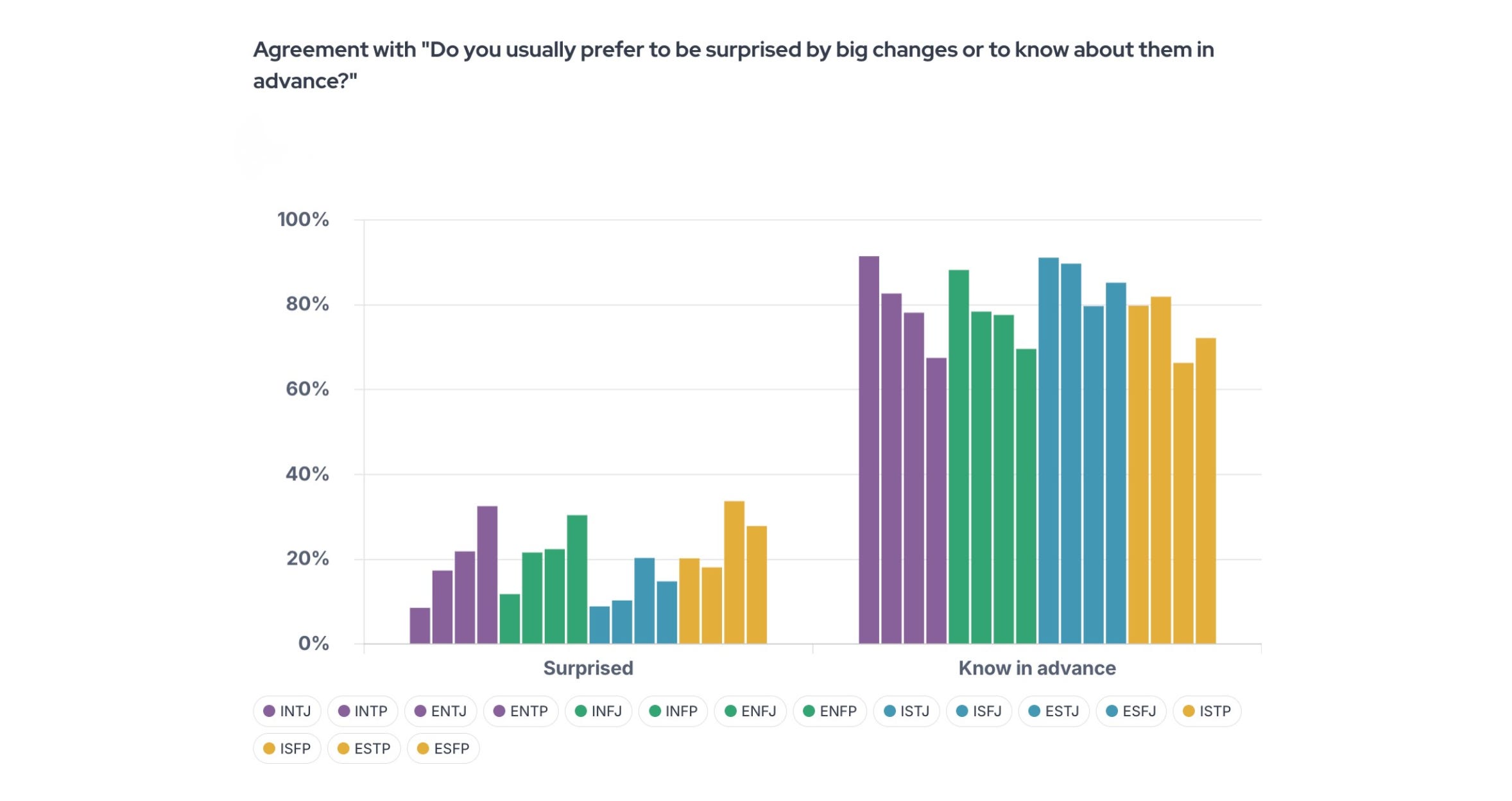
Across all 16 personality types, people were more likely to say they’d rather know about a big change ahead of time than be surprised by it.
INTJs (Architects) and ISTJs (Logisticians) felt most strongly about it, with 91% of each preferring advance notice. Even the majority of ESTPs (Entrepreneurs), who were the most open to surprises, still preferred a heads-up, at 66% agreement.
And only about a third of ENTPs (Debaters) said they’d rather be surprised. So even for these more spontaneous types, most people still wanted to know what was coming.
Insight to Action
The layoff itself may have blindsided your team, and you may have had no control over that. But you probably do have more control over what comes next – new responsibilities, shifting priorities, reporting changes.
When you can give people a heads-up, give it. Even the people on your team who usually enjoy a little spontaneity are likely to appreciate knowing what’s coming.
2. Do you prefer for change to happen slowly or all at once?
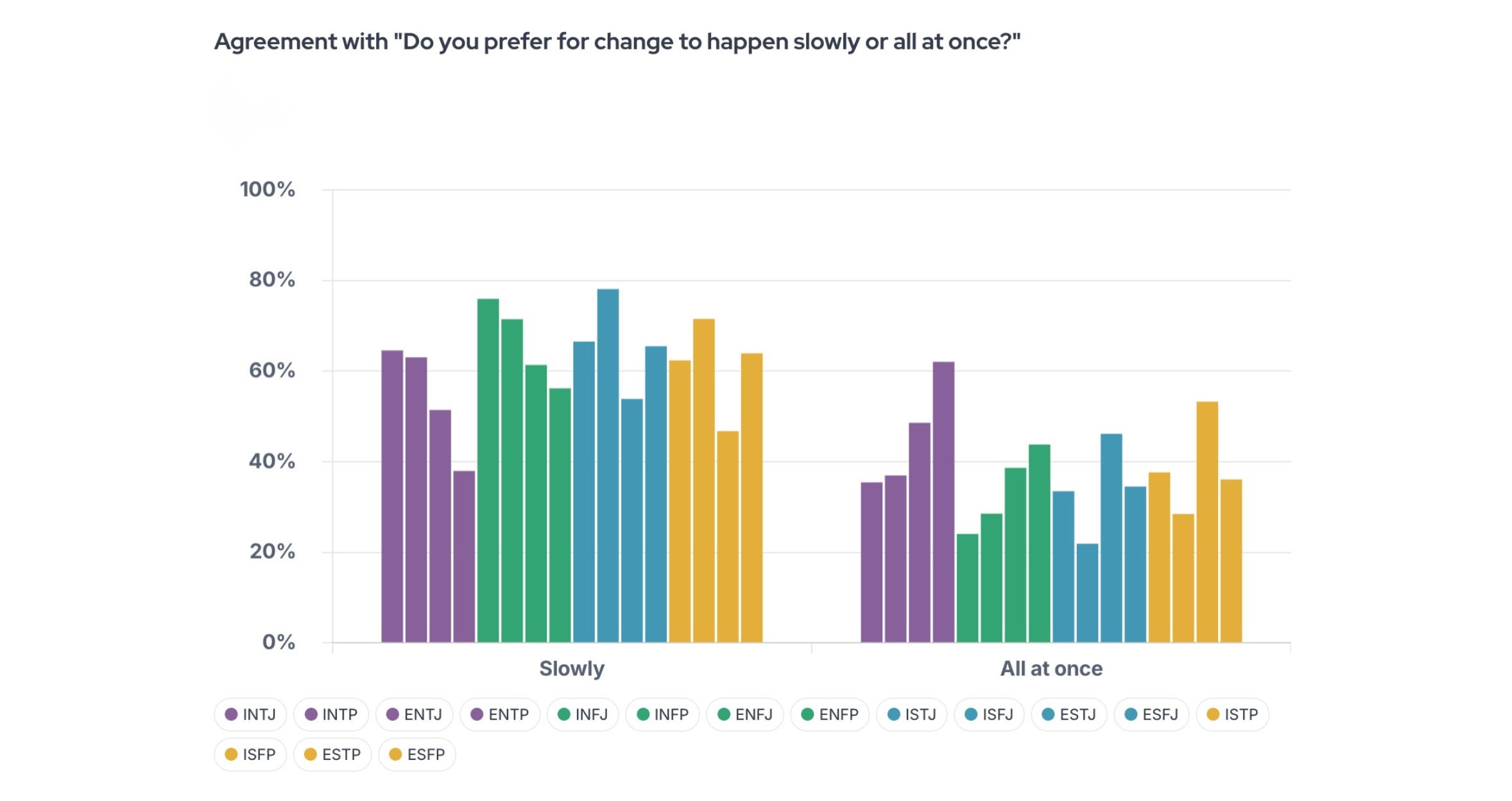
Most personality types said they’d rather change happen gradually, often by a pretty wide margin. ISFJs (Defenders) felt most strongly about it at 78%, followed by INFJs (Advocates) at 76%.
Only two types preferred getting it all over with at once: 62% of ENTPs and 53% of ESTPs. Both are Extraverted and Prospecting, traits that tend to make people more comfortable adjusting as they go.
What’s interesting is that even some of the types who generally say they like change still wanted it in stages. ENTJs (Commanders), ESTJs, and ENFPs (Campaigners) all tend to be relatively open to change, but a majority still preferred not to have everything change at once.
Insight to Action
After a layoff, it can be tempting to use the moment to make every other change that’s been waiting in the wings. But for most people, that can feel like a lot to absorb on top of everything else.
Where you can, spread the changes out instead of piling them on all at once.
3. How hard do you usually resist unwanted change?
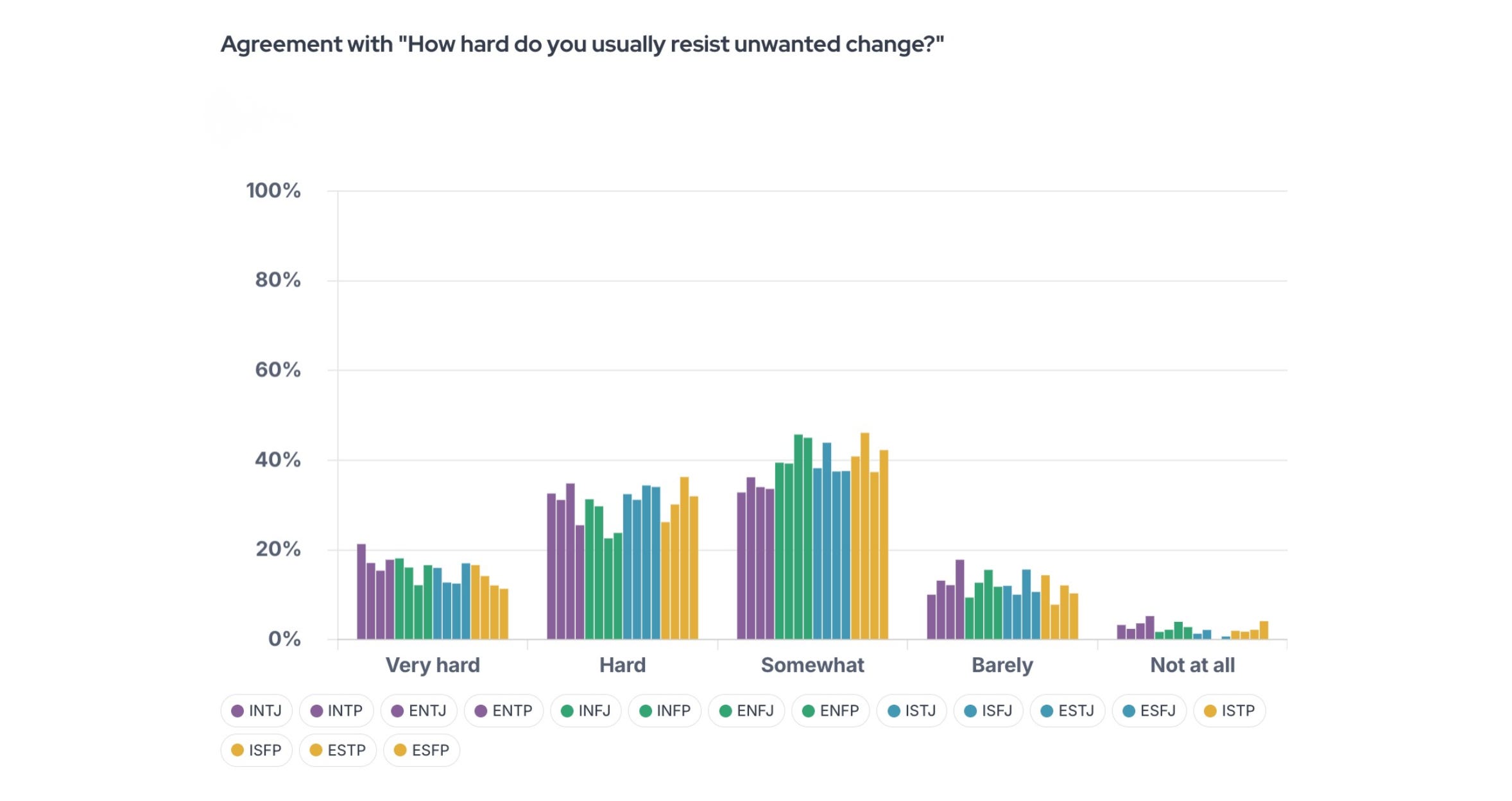
Very few people said they take unwanted change completely in stride. But very few saw themselves as impossible to budge either.
For 15 of the 16 personality types, “Somewhat” was the most common answer.
INTJs were the most likely to resist strongly, with about 54% choosing “Hard” or “Very hard.” ESFJs (Consuls) were close behind at roughly 51%.
At the other end, ENFJs (Protagonists) were the least likely to dig in, with only about 35% of people choosing the two strongest options. And roughly 23% of ENTPs said they barely resist unwanted change or don’t resist at all.
What’s interesting is that this didn’t break neatly along the Introvert–Extravert line. Resistance seems to have less to do with how social someone is and more to do with what, exactly, they feel is being disrupted.
That’s worth remembering after a layoff.
Insight to Action
If someone pushes back on another change following a layoff, it doesn’t necessarily mean they’re being difficult. They may be reacting to the loss of something they had put real time and effort into – a system that worked, a plan they believed in, or a team they helped build.
So before you write off resistance as stubbornness, ask what they feel they’re being asked to give up.
Not sure how the people on your team are likely to react to what comes next? Our Team Assessments show your team’s personality mix in one view, so you can plan changes with the people affected by them in mind.
4. Do you usually welcome support from others during times of significant change?
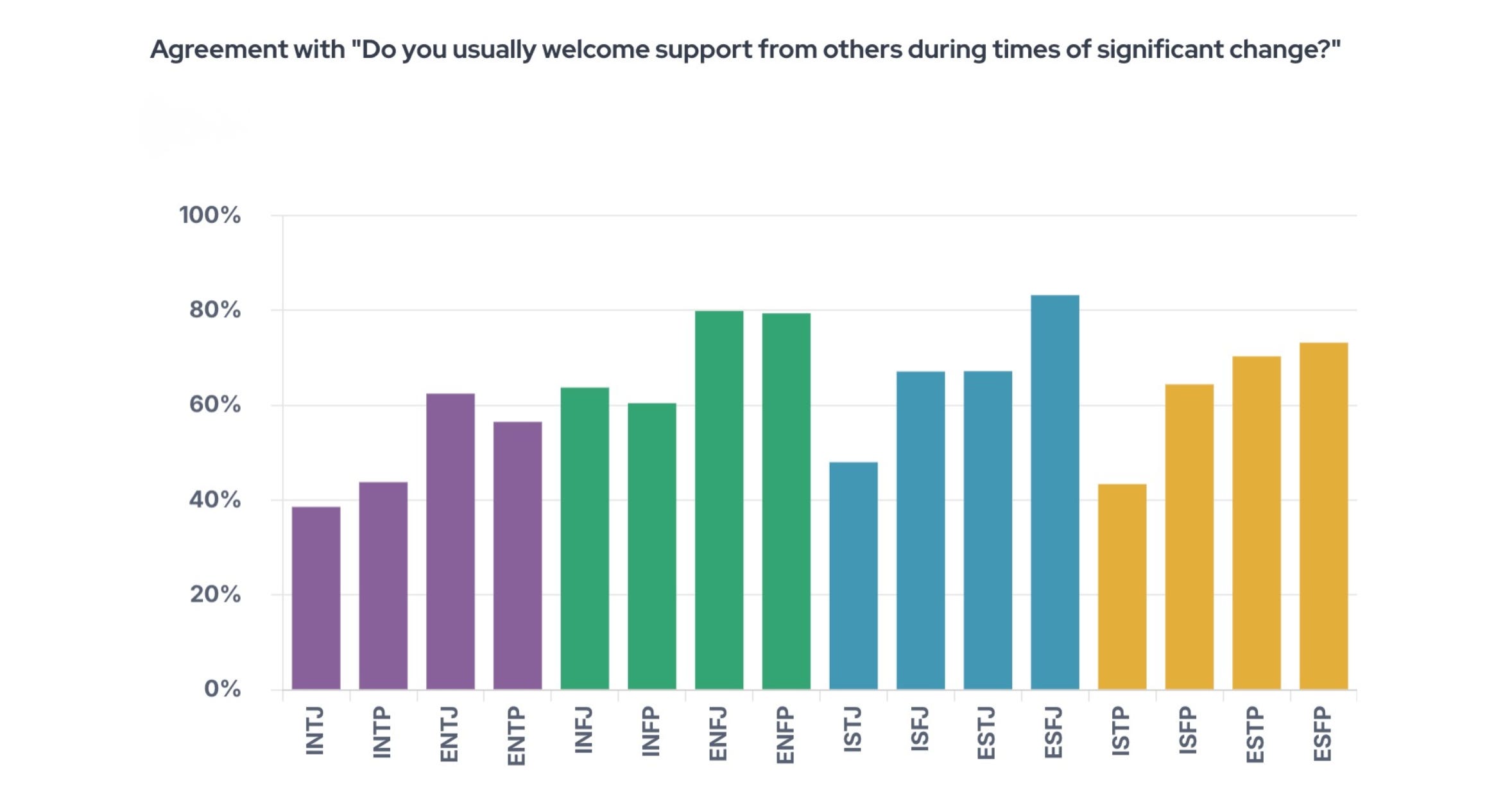
The Thinking–Feeling divide showed up in the responses to this question.
ESFJs were the most likely to welcome support, at 83%, and every Feeling type came in above 60%.
INTJs were at the other end, with just 39% saying they usually welcome support during a major change. ISTPs and INTPs (Logicians) weren’t far behind, and Introverted Thinking types made up the bottom four positions – with a gap of more than 40 points from top to bottom.
But that doesn’t mean Thinking types don’t want help. The kind of help matters.
Insight to Action
After a layoff, someone may have very little interest in sitting down to talk about how they’re feeling. They may be much more grateful if you clear up their priorities, make a decision they’ve been waiting on, or take something unnecessary off their plate.
So if someone says, “I’m fine,” don’t force the heart-to-heart.
Just make sure a heart-to-heart isn’t the only kind of support you’re offering.
5. Are you usually optimistic about significant life changes?
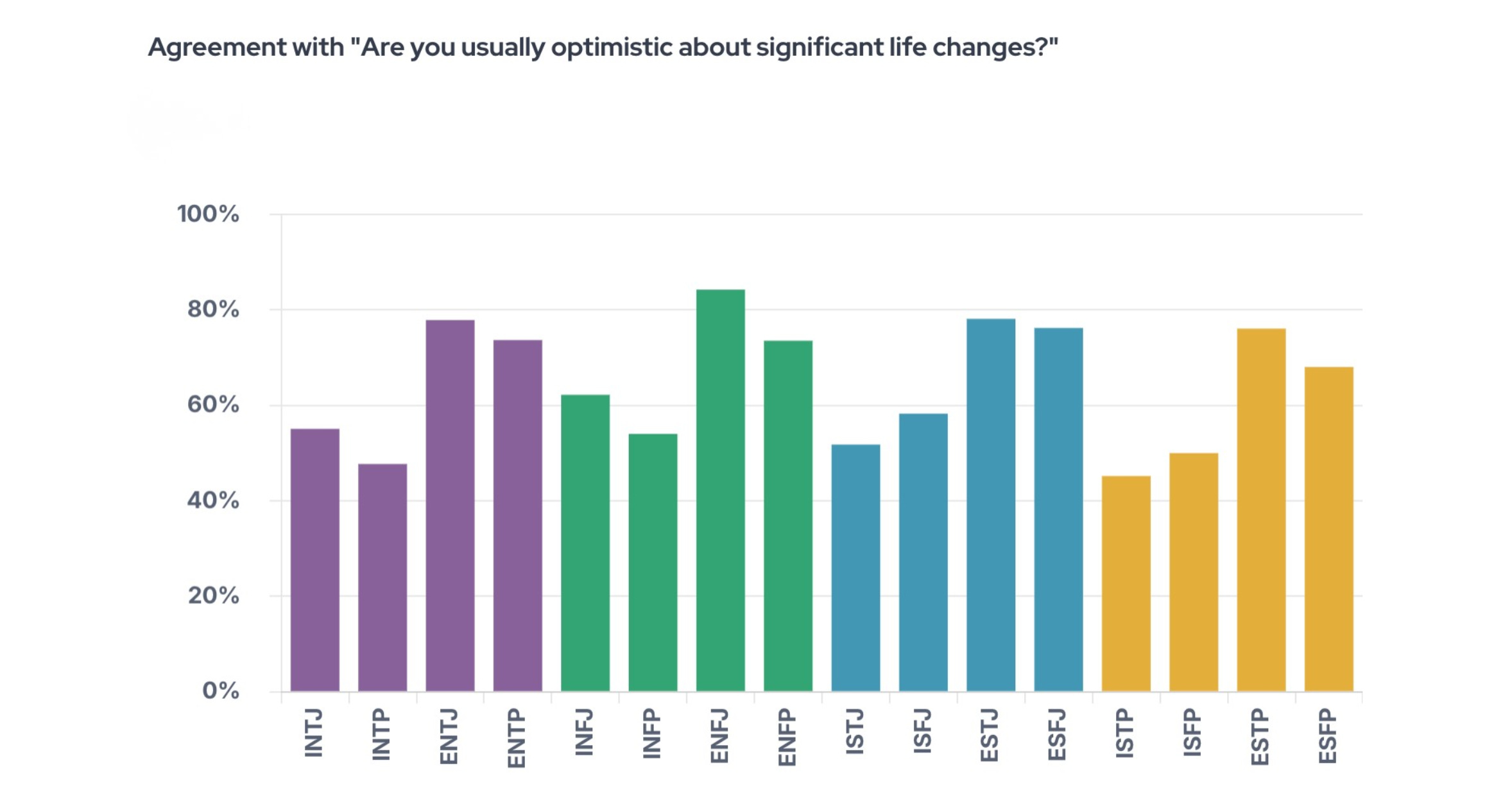
Extraverts were noticeably more optimistic about big life changes.
ENFJs came in highest, with 84% saying they’re usually optimistic about significant change. Every Extraverted type was at 68% or higher.
Introverts were more cautious. Every Introverted type came in below 63%, with ISTPs lowest at 45%.
There was another interesting pattern too: the types who felt they had handled past changes especially well – ENTJs at about 80% and ESTJs at 76% – were also among the most optimistic about future ones.
For leaders, the takeaway here is that not everyone on your team is going to look at the next big change and immediately see the upside.
Insight to Action
If an Introverted team member sounds more skeptical about a change than you do, that doesn’t automatically mean they’re negative or checked out. They may simply be thinking through what could go wrong before they buy in.
And sometimes, that’s exactly the perspective you need.
Not sure which types you’re leading? Sharing our free personality test with your team is a quick way to find out – and an easy conversation starter for your next one-on-ones.
The Bottom Line
Put all five charts together, and the pattern is pretty simple.
Most people want some warning before a big change. Most would rather not have everything change at once. And if they didn’t ask for the change in the first place, some resistance is normal.
Personality mostly changes what helps from there – whether someone wants more information, more time, more support, or more room to figure things out on their own.
One last finding feels especially important after a layoff: a majority of every personality type said that changes outside their control have significantly changed who they are, from INFPs (Mediators) at 73% to ESTPs at 53%.
So the team that comes out the other side of a layoff may not be exactly the same team you had before.
And you may not be exactly the same leader either.
You can’t control all of that. But you can make the changes that come next a little easier to see coming, understand, and adjust to.
Which of these charts matched your own experience with change – and which one surprised you? Let us know in the comments.